Task 3a – Refraction
Have you ever noticed this effect?
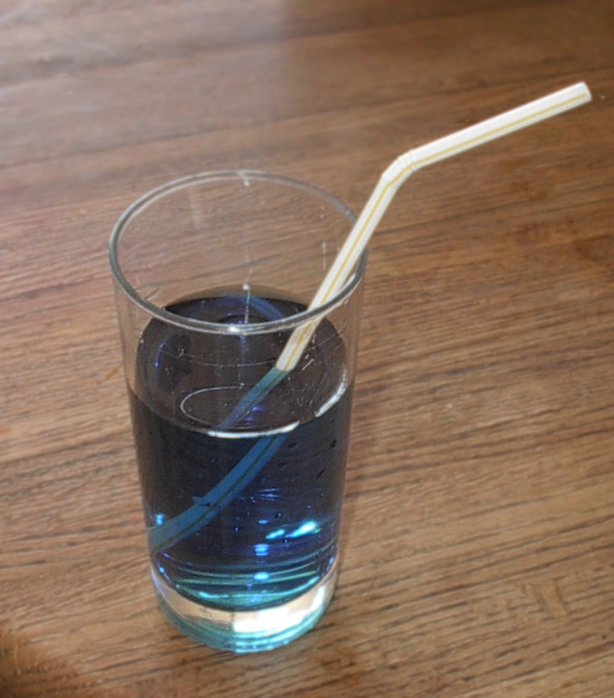
a) Use a ray box with a single slit and a glass/perspex block to make ray diagrams of light changing direction on moving from air to glass/perspex and back again.
b) This happens because of refraction. Use one of these sites (or click here to search for ‘refraction A-Level‘) to find out about why it happens and write up an explanation in your own words.
Snell’s Law
Snell’s Law links the angle of incidence (the ray coming in) and the angle of refraction (how much it changes direction when it goes into the new material). Every material has a refractive index that can be used to calculate how much light will refract when it enters it. The refractive index of water is 1.33, which means that light travels 1.33 times faster in a vacuum (space) than in water. The refractive index of air is 1.0003, which means it is not much different to a vacuum.
c) Use this site to work out how to label your ray diagram, including the angle of incidence and angle of refraction. Use those numbers in this equation to estimate the refractive index of your glass/perspex block:
n = sin i
sin r
n = refractive index — sin i = sine of angle of indience — sin r = sine of angle of refraction
Find out the refractive index of glass/perspex. How close was your experiment to the true value?
Write these up for your portfolio – include all diagrams and photos. Put all addresses of websites you’ve used in your bibliography.
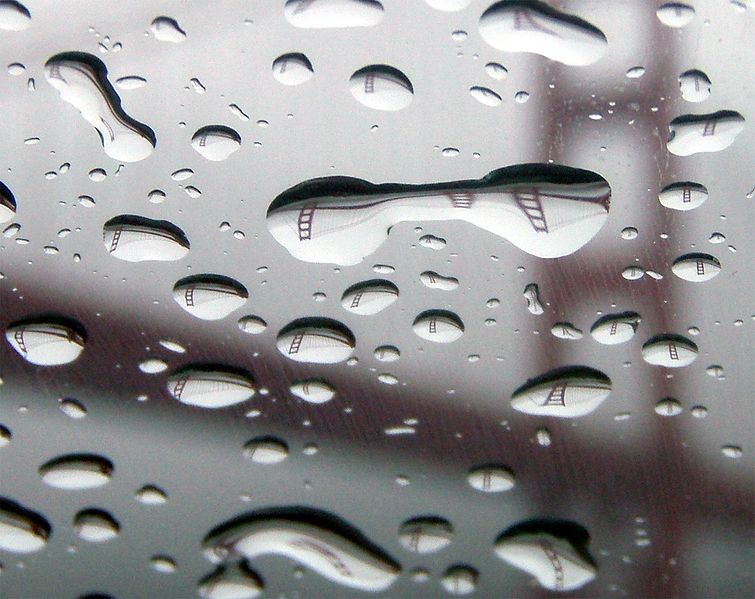
Lastly – just for fun – click on this photo for an amazing piece of refraction caused by drops of water on a camera lense:
Task 3b – Splitting White Light
a) Use a ray box with a single slit and a prism to split white light into a spectrum. Photograph this for your portfolio and find a ray diagram/image from the web showing the same effect. Write down what you’ve seen.
b) Why do some parts of white light refract more than others – what’s different about the different colours that make up white light?
c) This site has wavelengths of various colours of light. Use the information and the equation below to make a table showing the wavelength and frequency for the colours.

NB: 1 nm = 0.000000001 m
d) What is the relationship between wavelength and frequency of light?
Write these up for your portfolio – include all diagrams and photos. Put all addresses of websites you’ve used in your bibliography.